
Ernie Hobbs is the founder and CEO of Genstrata, Inc., the company behind GauntletScore. He has spent more than thirty years in sales and marketing in the world of diagnostics and genomics and life sciences software with companies like Roche, Thermo Fisher Scientific, Congenica, Seven Bridges, and BioTuring. That world runs on controls and verification. Unfortunately most of the AI drafting just doesn't. GauntletScore exists to close that gap. He lives near Winston Salem, North Carolina.
ABOUTErnie Hobbs Jim Hinson
The people behind the score

Jim Hinson is Co-Founder and CTO of Genstrata, where he leads technical strategy, security, and hands-on engineering for the company's AI-powered independent document verification platform. He brings 30+ years of software engineering and quality leadership to the problem of AI trust, having built teams and automation frameworks at companies spanning cloud infrastructure, healthcare, education, and legal technology. A Microsoft alumni, Jim holds a B.S. in Computer Science from NC State. He's based in the Triad area of North Carolina.
My name is Ernie Hobbs. I never set out to build a verification company. I wanted to build tools that would let me do more of what I do. And I kept hitting the same wall over and over and over.
I'm not an engineer. I've spent my whole career in diagnostics and life sciences on the commercial side, where I've sold other people's products. When AI coding and writing tools got good enough to matter, those were the first tools that let somebody like me build the thing he could describe.
I built three or four things that looked really good. They were all facades. There'd be a stretch where I'd get excited, and it was just awesome, and it looked like it was going to work. Then I'd show somebody and it fell apart on the first real question. My AI assistant always took the shortest path, cutting corners and taking the easy way out. I didn't have the experience to know the difference.
The same thing happened when I wrote
I asked AI to help me organize a few pages of real memories for my mom's eulogy. And it gave me back something that was clean and very moving. But it wasn't mine. It was a good story. It just wasn't true. So I threw that out and I did the rest by hand.
Later, I started using AI to help draft some of my outreach. I sent out one particular message where I gave credit to an attorney for a federal case that he had written about, but had never actually litigated. He wrote back the next morning. He clearly knew his own case list. Everything else in that message was sharp. It was very well organized. Everything was right. The one little false sentence read exactly like the true ones around it.
What those had in common
It wasn't code. It wasn't prose. I just couldn't tell what was true. I didn't know what was real.
Even if only fifteen or twenty percent of what came back was wrong, I still couldn't put my name on it, because I didn't know which fifteen or twenty percent it was. I had no way of knowing.
I stopped building the tool that I wanted and I started building the one I needed first. And so that's what I did.
What GauntletScore does
GauntletScore goes through all of those claims in the document and cross-references them to primary source material. If it's talking about something in court, it checks it against the court records. If it's talking about something in a filing, it checks it against the regulatory filings. If it's talking about something in medicine, it checks it against medical literature. It checks everything against the public record. There are several different LLMs that go out and gather all the evidence, and they argue amongst themselves. None of these models grade their own homework. They have no idea how good they are. Then the score is computed from that evidence with math that doesn't change. No model votes on the outcome. Then it puts a seal on it with a certificate that you can check for yourself. Finally, there's another pass where it uses causal validation and asks: What if every single one of those facts was actually true? Would your reasoning still hold up?
It catches things. It doesn't stop them. If you have a document that comes back clean, all that means is that it survived our particular checks, which is a much smaller claim than saying the document is true. I'd rather just make that smaller claim if I can get it right.
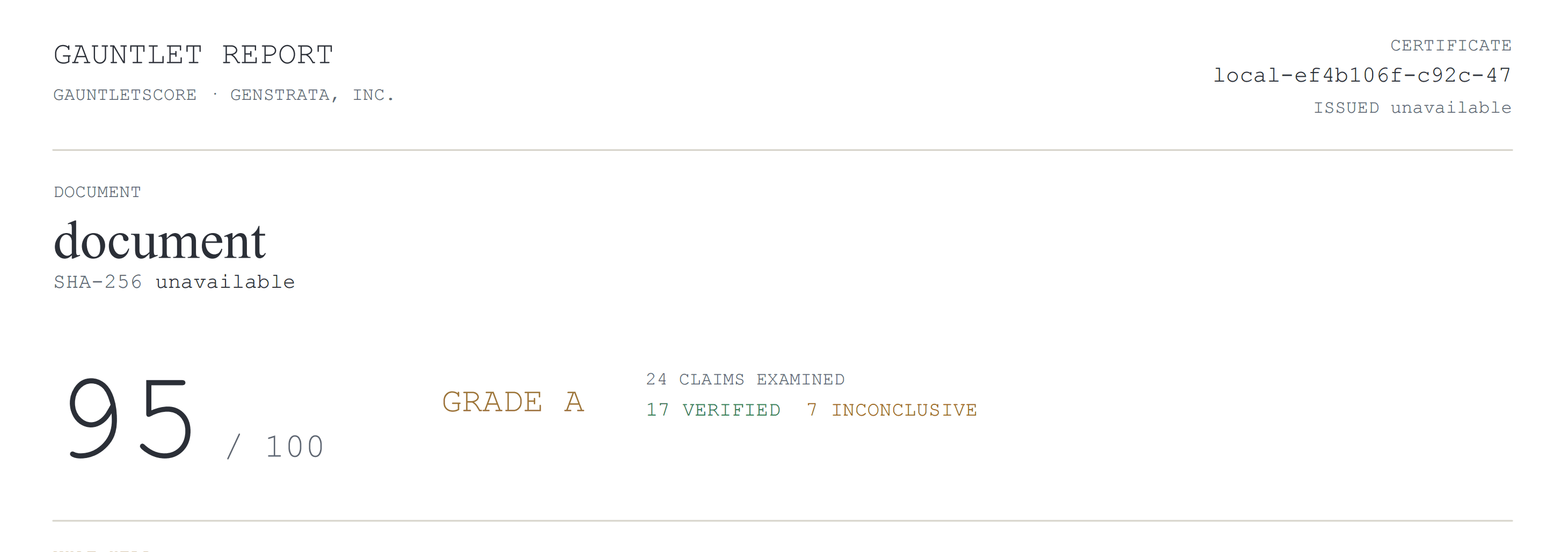
We run it on our own work first
My own check caught a problem with my internal data before it made it to a pitch deck. It downgraded a stat that I wanted to use. But if I can't run my own gauntlet, I have no business selling one.
I trusted it, and that was my mistake. It's not the only one I'll claim. I make lots of mistakes, but with the Gauntlet, I can catch them before they do real damage. I have learned that I can't trust any of these tools, and even now, knowing that, I still want to. Every time, I have to resist it. That's what GauntletScore is for.
On this website, you won't see any kind of numbers about how accurate we are. I've been very deliberate about that. We pre-registered a validation study before I was going to make any claim about how well we're doing publicly. The manuscript's still in preparation. It's not peer-reviewed yet. Until that work is done, I'd rather just hand you a signed certificate than quote you a number.
The part I do not do
I'm not a software engineer by trade. I've always been on the sales and marketing side of things. My co-founder and CTO, Jim Hinson, is the one who owns the production engineering side. He's my partner, the one who catches what I don't know to look for. So without him, it's a prototype. With him, it's a real product.
And my writing tools, which are what started all this, are still in the shop. Everything I draft goes through the same gate before a person ever gets to decide anything.
The rest
For about fifteen years, I've been a deacon in my church. In our tradition that's not a pulpit role. It's more of a behind the scenes job. It's making sure the building's open, everybody's got what they need, everything's set up properly. Once we're ready to go, you don't notice it. If I do it right, nobody ever notices. I've come to think that's what trust looks like in an organization. That's the quiet function that everything else depends on.
I went to Wake Forest University, Class of '94. Eleven years later, I went back to school to get an MBA at the University of North Alabama. Because I've always been a tinkerer with computers, my concentration was computer information systems. Since I've spent a long time selling software for life sciences, that has proven to be a good decision. I come from a family that just builds something if something needs fixing.
If you want to reach out to me, my email is ernie@genstrata.com, and you can find me on LinkedIn at https://www.linkedin.com/in/wmehobbs/.
GauntletScore is a product of Genstrata, Inc. Patent pending.
Run the document you received.
Analyze a Document
Three free credits. No card. No call.